(w)hole
Written during a visit to artist Anne Wilson’s Davis Street Drawing Room, an experimental and public facing art project, formed through an archive of textile parts and excavations from years of Wilson’s art-making. The piece was originally published for Bridge and thinks alongside Evelynn Hammonds' essay "Black (W)holes and the Geometry of Black Female Sexuality.”
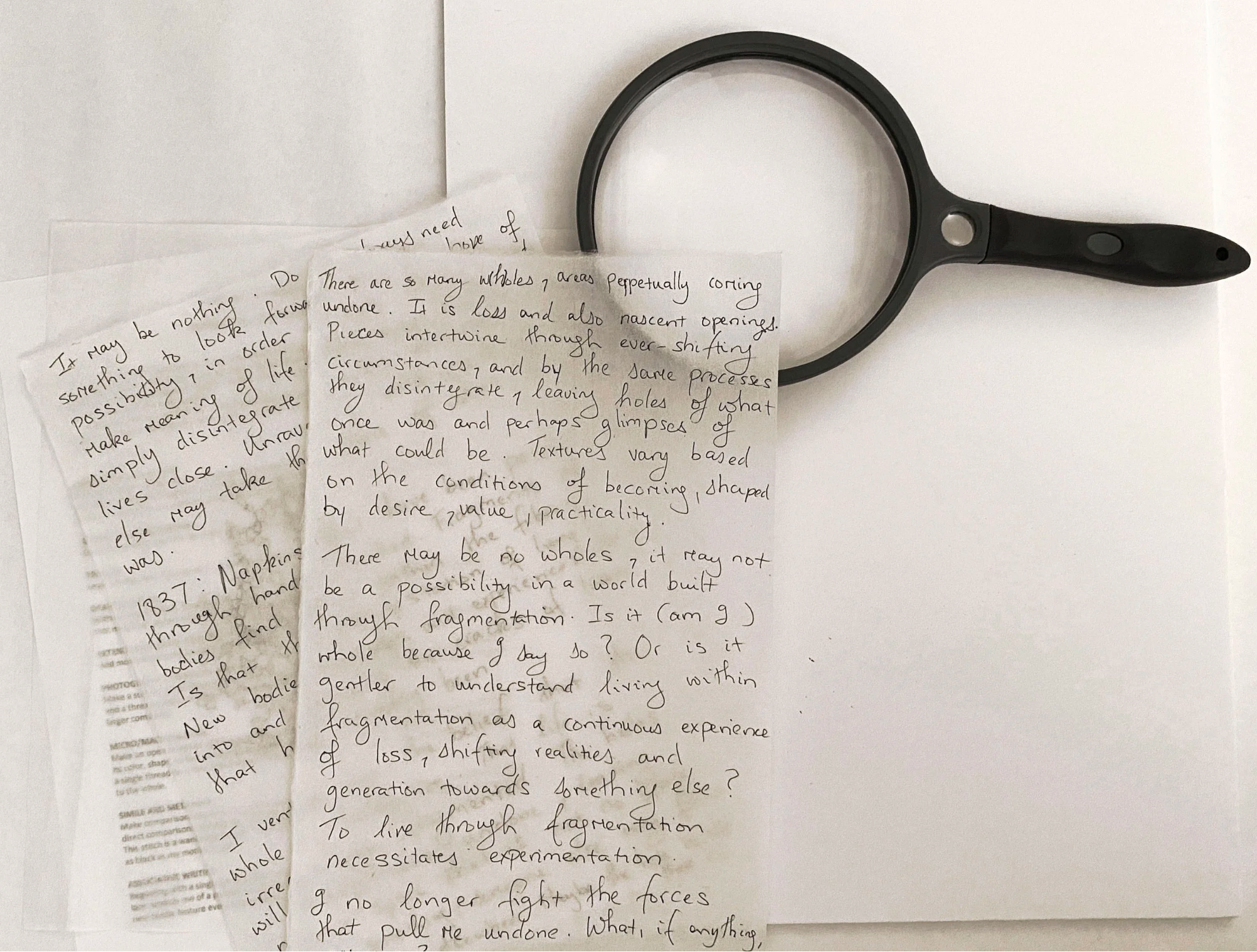
Davis Street Drawing Room, Gervais Marsh work space. Image courtesy the artist.
(w)hole
There are so many (w)holes, areas perpetually coming
undone. It is loss and nascent openings.
Pieces intertwine through ever-shifting
circumstances, and by the same processes
they disintegrate, leaving holes of what
once was and perhaps glimpses of
what could be. Textures vary based
on the conditions of becoming, shaped
by desire, value, practicality.
There may be no whole, it may not
be a possibility in a world built
through fragmentation. Is it (am I)
whole because I say so? Or is it
gentler to understand living within
fragmentation as a continuous experience
of loss, shifting realities and
generating towards something else?
To live through fragmentation
necessitates experimentation.
I no longer fight the forces
that pull me undone. What, if anything,
emerges?
It may be nothing. Do I always need
something to look forward to, the hope of
possibility, in order to move through and
make meaning of life? And also things
simply disintegrate, worlds dissolve and
lives close. Unraveling. Nothing else
may take the place of what once was.
1837: Napkins that have been passed
through hands. Touched. Fragments of
bodies find space within the fibers.
Is that the manifestation of living?
New bodies, memories and experiences fitting
into and exploding the cracks of lives
that have already been.
I venture into the belief that the
whole is subjective. That life is
irreconcilably fragmented. The holes
will always come undone, leaving
negative space that is not no space.
Maybe something/someone else may fill it
in or gesture elsewhere. Maybe the hole is all
there is.